
The Virtual Round Table organized by the Indian Council for Technical Research and Development (ICTRD) on 18th July 2026 brought together academicians, industry leaders, researchers, and innovation experts to discuss a critical question for India’s future: How can Indian universities transform research into innovation, entrepreneurship, and economic value? At a time when India is advancing towards the vision of Viksit Bharat 2047, the discussion emphasized that universities must move beyond knowledge creation and become active drivers of innovation, technology development, and societal transformation.
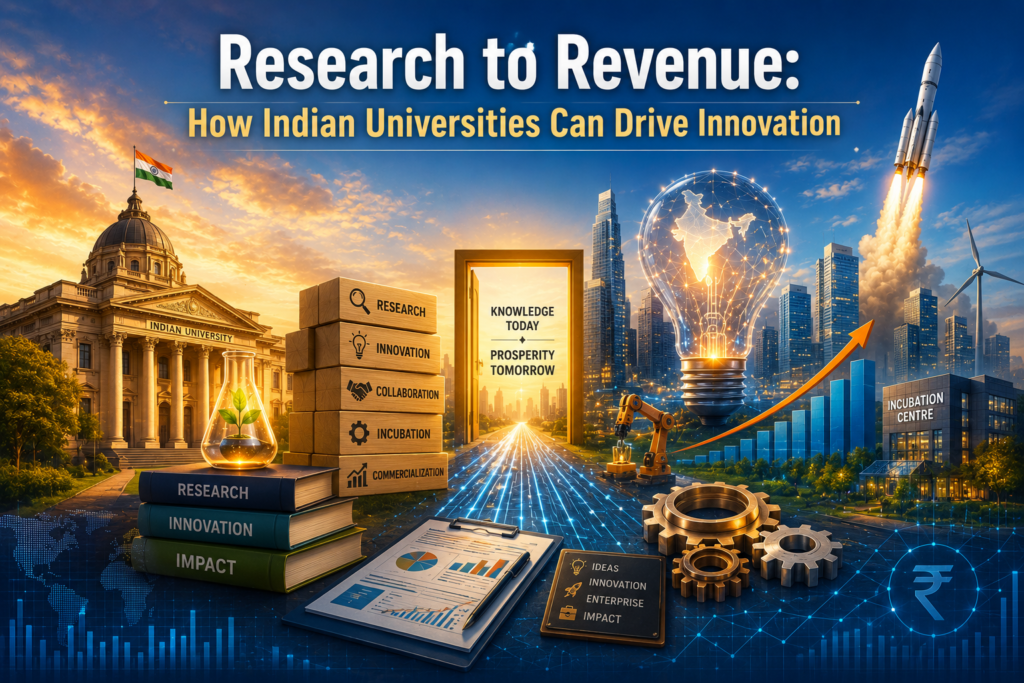
From Research to Real-World Impact
Opening the session, Siddharth Roy, Director of Communication, highlighted that India produces a significant volume of research and academic knowledge every year, yet only a small portion translates into market-ready solutions or societal impact. He emphasized the need to build stronger pathways that connect research with industry, entrepreneurship, and innovation.
Building on this, Dr. Ashish Sasankar, Chairman, ICTRD, stressed that universities must evolve into centres of innovation and entrepreneurship. Referring to the aspirations of NEP 2020, he noted that research should not be measured solely through publications and citations, but through patents, technology transfer, startups, and measurable contributions to national development.
Dr. Ketan Mohitkar, Member Secretary, ICTRD, further emphasized that the journey from research to revenue is ultimately a journey from knowledge to impact. He encouraged institutions to create innovation ecosystems where research leads to practical solutions, entrepreneurship, and sustainable growth.
Universities as Innovation Ecosystems
A key theme emerging from the discussion was the need for universities to become complete innovation ecosystems rather than traditional teaching institutions.
Experts highlighted that research should begin with solving real-world challenges and focus on creating value for society. Universities were encouraged to strengthen industry partnerships, promote interdisciplinary research, establish incubation centres, support startups, and develop effective technology transfer mechanisms. The focus, participants agreed, should shift from publication-driven success to impact-driven innovation.
Key Areas of Transformation
The round table identified several areas where universities can accelerate the transition from research to revenue:
● Industry-academia collaboration to align research with market needs.
● Patent development and commercialization of intellectual property.
● Startup incubation and entrepreneurship support.
● Consultancy, executive education, and technology licensing as alternative revenue streams.
● Skill development and lifelong learning initiatives that connect research with employability and
community development.
Collectively, these efforts can create a stronger bridge between academic excellence and economic growth.
Perspectives from Participating Experts
The discussion was enriched by insights from distinguished speakers representing academia and industry.
Dr. Murari Lal Gaur emphasized that research must address grassroots challenges and create measurable societal value. He advocated diversified revenue models, stronger industry engagement, and greater collaboration among institutions.
Dr. Samit Mahore highlighted the role of public universities in balancing revenue generation with public welfare, skill development, and community impact.
Mr. Girish K. Nair stressed the need for stronger commercialization mechanisms and better support systems that enable promising research to reach the marketplace.
Dr. Suneet Mathur underlined the importance of industry partnerships, entrepreneurial thinking, and institutional policies that encourage commercialization and innovation.
Dr. Meghana Manohar Jalgaonkar highlighted India’s “research translation deficit” and called for greater focus on converting knowledge into innovation, entrepreneurship, and economic value.
Mr. Sankar Paul emphasized that innovation requires a change in mindset and stronger collaboration among universities, researchers, and industries.
Dr. Amol Bhagwat Kasture pointed out that patent generation alone is insufficient unless innovations are successfully commercialized and translated into products, startups, and solutions.

Challenges on the Path Ahead
While the opportunities are immense, the discussion also highlighted several challenges:
● Weak research commercialization
frameworks.
● Limited industry-academia
collaboration.
● Low awareness of intellectual property
and technology transfer.
● Funding gaps during the
commercialization stage.
● Institutional incentive systems that
prioritize publications over impact.
Participants agreed that overcoming these barriers will be critical for strengthening India’s innovation ecosystem.
ICTRD and the Role of Collaborative Platforms
The Indian Council for Technical Research and Development (ICTRD) continues to play an important role in fostering collaboration among academia, industry, researchers, and policymakers. Through initiatives such as the Virtual Round Table series, ICTRD provides a platform for knowledge exchange, practical insights, and actionable recommendations that support India’s innovation-driven future.
Conclusion
The round table concluded with a shared understanding that India’s future competitiveness will depend on its ability to transform research into innovation, innovation into enterprise, and enterprise into national development. Universities must become catalysts of entrepreneurship, technology transfer, and societal impact, ensuring that research creates measurable value beyond academic publications. Through stronger collaboration, supportive policies, and a culture of innovation, Indian universities can play a transformative role in building a knowledge-driven and innovation-led economy aligned with the vision of Viksit Bharat 2047.