
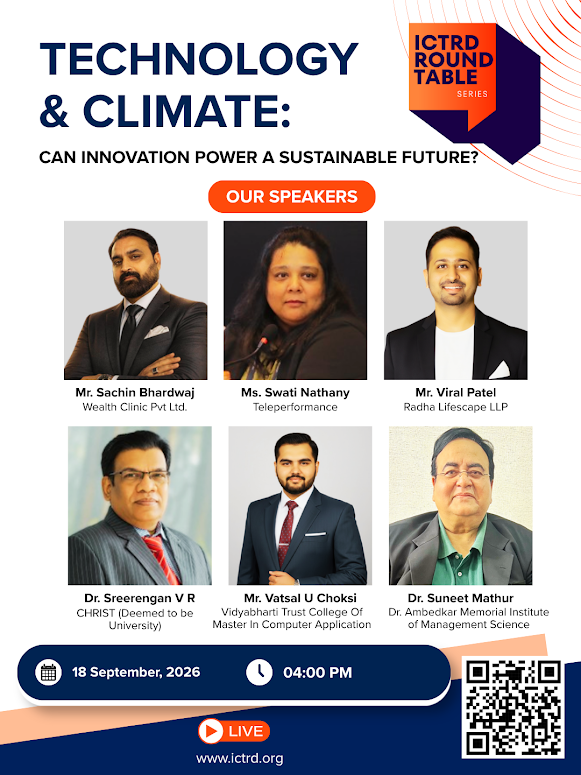
The Indian Council for Technical Research and Development (ICTRD) organized its Virtual Round Table Meeting 9.0 on 18 September 2026, bringing together academicians, industry leaders, researchers, and professionals to discuss an important question: Can technology and innovation help build a sustainable future?
With artificial intelligence, data centres, automation, smart infrastructure, and digital technologies rapidly transforming society, the discussion explored both sides of technological progress the opportunities it creates and the environmental resources it
consumes.
The session highlighted an important reality: technology can help address environmental challenges, but the technologies themselves also require significant amounts of energy, water, infrastructure and raw materials. This makes the question of responsible and sustainable innovation increasingly important.

Technology and Sustainability: Finding the Balance
Opening the session, Mr. Siddharth Roy, Director of Communication, ICTRD, highlighted the growing connection between technology, innovation, and sustainability. He noted that technologies such as AI, smart grids and digital infrastructure are changing how resources are consumed and managed, while also creating new environmental challenges.
Dr. Sreerengan V R emphasized that sustainable innovation should work in harmony with nature. He highlighted design thinking, sustainable agriculture, green construction materials, clean energy, and circular approaches such as reuse, repair and recycling.
One practical example discussed was precision farming and regenerative agriculture, which can help improve agricultural yields while reducing emissions and water consumption. In construction, the use of low-carbon cement and timber re-engineering was highlighted as a way of reducing the environmental impact of construction activities.
Clean energy was another important area of discussion. Along with solar and wind power, Dr. Sreerengan pointed to wave energy as a relatively underexplored opportunity in India, given the country’s access to the Arabian Sea, Indian Ocean and Bay of Bengal.
Making Technology More Responsible
Mr. Viral Patel emphasized that technology alone cannot solve climate challenges. Responsible leadership, sustainable business models, public policy and measurable action are equally important.
He highlighted several practical applications of AI and digital technologies in sustainability. These include forecasting energy demand, optimizing power grids, identifying water leakages, monitoring deforestation, improving waste segregation, predicting equipment failures and optimizing renewable-energy use.
The discussion therefore moved beyond the idea of technology simply making processes faster or more convenient. Instead, the focus was on using technology to create measurable improvements in resource efficiency and environmental performance.
Four priorities were highlighted: energy-efficient digital infrastructure, data-driven sustainability, circular technology and supply chains, and inclusive innovation.
This is particularly relevant as AI, cloud computing and data storage continue to expand. The growing demand for digital infrastructure makes energy efficiency an important consideration in the design and operation of future technology systems.
Renewable Energy and Measurable Impact
Dr. Suneet Mathur discussed the declining costs of solar, wind and battery technologies and the opportunities they create for reducing dependence on fossil fuels.
One specific data point highlighted during the discussion was that solar tariffs in India had reached approximately ₹2.53 per kilowatt-hour, reflecting the significant change in the economics of renewable energy.
However, lower technology costs do not automatically guarantee lower environmental impact. Dr. Mathur discussed the rebound effect, or Jevons paradox, where improvements in efficiency or reductions in cost can sometimes lead to increased consumption.
He also highlighted challenges including the need for significant capital investment, critical minerals such as lithium and copper, stranded-asset risks, inflation and geopolitical pressures.
Another concern was greenwashing the gap that can sometimes exist between sustainability claims and measurable environmental outcomes. The discussion therefore emphasized the importance of scaling proven technologies while tracking actual emissions and verified environmental performance.
Technology for Agriculture and Resource Efficiency
Ms. Swati Nathany highlighted how AI and digital technologies can support sustainable agriculture.
One example was the National Pest Surveillance System, which can help farmers identify when pest control is actually required instead of relying on blanket pesticide application. Such targeted interventions can support more efficient use of agricultural inputs.
She also highlighted AI-based monsoon forecasting, supported by long-term data and the experience of the India Meteorological Department, as an important tool for improving agricultural planning and decision-making.
Her approach to sustainable technology was summarized through three actions: Reduce unnecessary consumption, Replace carbon-intensive systems, and Regenerate resources through smarter use.
The discussion also touched upon green hydrogen, smarter energy systems and battery-swapping infrastructure as emerging areas that could support the transition towards cleaner systems.
Mr. Sachin Bhardwaj further highlighted the importance of water efficiency, particularly as AI, cloud computing, digital services and data centres expand.
While discussions around AI infrastructure often focus on electricity consumption, he drew particular attention to water consumption, emphasizing that treated wastewater could be considered for suitable industrial and technological applications so that fresh water can be prioritized for essential human needs.
His central message was that sustainable technology should deliver greater value while using fewer resources particularly energy, water and physical space.
From Regulation to Environmental Performance
Dr. Ketan Mohitkar, Member Secretary, ICTRD, emphasized the need to balance environmental protection with economic and industrial development.
He highlighted several technologies that can support this balance, including AI for optimizing energy consumption, IoT for real-time emissions monitoring, satellite technology for monitoring forests and water bodies, smart grids for reducing energy wastage, and data analytics for predicting environmental footprints.
A key point was the need to move beyond paperwork-driven compliance towards data-based environmental performance.
Instead of focusing only on whether an organization has complied with a particular requirement, environmental performance can increasingly be assessed through reliable data, measurable outcomes and consistent monitoring. This approach can strengthen both
accountability and transparency.
The Resource Challenge of Digital Growth
The Q&A session brought another important dimension to the discussion: the physical resources required to support digital growth.
Participants highlighted the electricity and fresh-water requirements of AI systems and data-centre cooling. The discussion also examined the growing resource requirements of
India’s semiconductor ecosystem, including water and energy requirements associated with semiconductor manufacturing and supporting infrastructure.
Participants emphasized the need for water-efficient cooling technologies, energy-efficient systems and resource-saving manufacturing practices as these sectors expand.
The discussion also addressed responsible AI adoption. Rather than asking only whether AI is “green”, participants suggested considering whether a particular AI application is necessary, verifiable and capable of creating meaningful value for society.
Applications with clear societal benefits, particularly in areas such as healthcare and agriculture, were highlighted as examples where technology can potentially deliver greater social value.
Key Takeaways
The discussion highlighted several priorities for sustainable technological development:
● Energy- and water-efficient digital infrastructure
● Greater use of renewable energy and storage
● Circular approaches to products and supply
chains
● Responsible and purposeful AI adoption
● Data-driven measurement of environmental
performance
● Sustainable design from the beginning
● Inclusive access to green technologies
● Smarter and more transparent environmental
regulation
A recurring theme throughout the session was that sustainability should not be treated as something added after a technology or product has been developed. Instead, environmental considerations should be incorporated at the design stage itself.
Conclusion
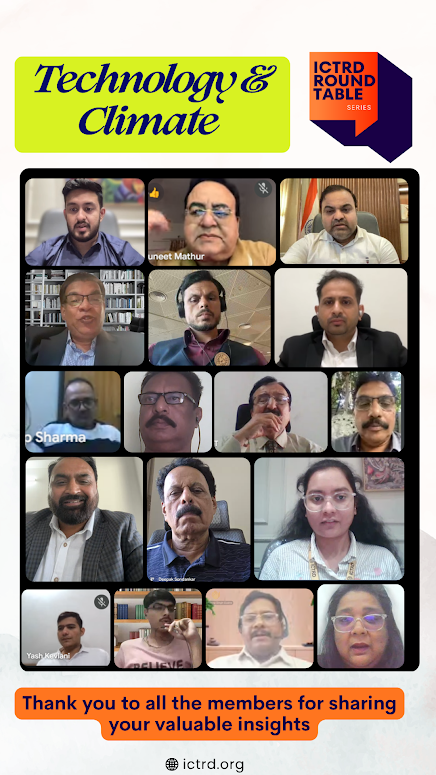
The ICTRD Virtual Round Table highlighted that technology can be both a source of environmental pressure and a powerful tool for addressing environmental challenges.
The path forward lies not in choosing between technology and sustainability, but in developing technology that is efficient, responsible, measurable and purposeful.
From renewable energy and precision agriculture to AI, smart grids, circular supply chains and resource-efficient data centres, the discussion demonstrated that technological innovation can contribute to sustainability when it is guided by clear objectives and
measurable outcomes.
Ultimately, the question is not simply “What can technology do?” but also:
“What should technology do for people and future generations?”
Building a sustainable future will therefore require more than technological progress. It will require responsible innovation, supportive policies, skilled people, measurable environmental outcomes and collaboration across academia, industry, government and society.