
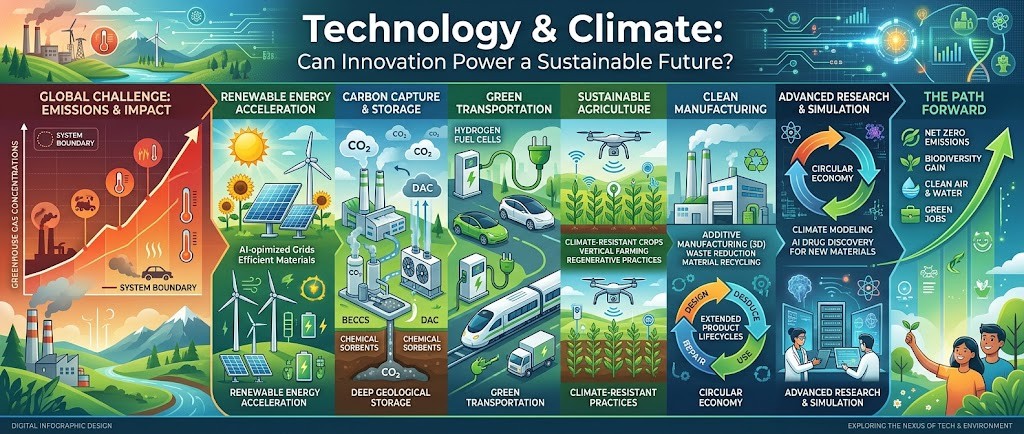
As AI and digital infrastructure expand globally, India has an opportunity to design the next generation of technology around energy efficiency, water security and measurable environmental performance.
The global question
Artificial intelligence is moving rapidly from a specialised technology to an essential layer of the modern economy. It is changing how businesses operate, how governments deliver services, how industries optimise production and how people access information.
But every digital service ultimately has a physical footprint.
Behind an AI model or cloud application are servers, semiconductors, buildings, electricity networks, cooling systems, water, land and increasingly complex supply chains.
The central question, therefore, is not whether technology should grow. Technology will grow.
The more important question is:
Can technology grow without transferring its costs to the resources and ecosystems on which future growth depends?
The scale of the challenge is becoming clearer. According to the International Energy Agency’s 2026 update, data centres consumed approximately 485 TWh of electricity globally in 2025. The IEA projects this to roughly double to about 950 TWh by 2030, representing around 3% of global electricity demand. Electricity
consumption from AI-focused data centres is projected to grow even faster, tripling over the same period.
At first glance, 3% may not appear particularly large. But geographical concentration matters. Data-centre
electricity demand is often concentrated in specific regions, creating much greater pressure on local
electricity networks and infrastructure than the global percentage suggests. The IEA reports that global data-
centre electricity consumption grew by 17% in 2025, while electricity consumption from AI-focused data centres grew by 50%.
That changes the nature of the debate.
We should not ask only: “How much electricity does AI consume?”
We should also ask: Where is that electricity coming from? What other resources are being consumed? What
infrastructure is required? And what value is being created in return?
The AI energy paradox
On one side, increasingly powerful computing requires more electricity and infrastructure. On the other, AI can potentially make existing systems more efficient.
AI is already being explored for optimisation of electricity networks, industrial processes, buildings, transport, agriculture and water systems. In its 2025 Energy and AI analysis, the IEA estimated that widespread adoption of existing AI applications could potentially reduce energy-related emissions by around 5% in 2035, while cautioning that barriers to adoption and rebound effects could limit the actual benefit. AI is therefore a potential tool for emissions reduction—not a substitute for broader climate and energy policy.
This leads to a useful way of thinking about AI:
We should measure not only the resources AI consumes, but also the resources it helps us save.
I would call this “Resource Return on AI.”
This is not an established international standard. It is a proposed framework for thinking about the resource efficiency of AI, particularly as AI moves into large-scale infrastructure.
If an AI application consumes energy and computing resources, how much energy, water, material, time or
carbon does it help society save?
That question could become increasingly important as AI moves from experimentation into large-scale
infrastructure.
India’s digital infrastructure moment
India is particularly important in this conversation because its digital economy is expanding at the same time
as its energy transition is accelerating.
Government data shows that India’s installed data-centre capacity increased from approximately 375 MW in
2020 to about 1.57 GW in August 2026. The Government has indicated that data-centre power demand could reach approximately 17 GW by 2031–32.
The expansion is also becoming geographically broader. While major hubs include Navi Mumbai, Chennai,
Hyderabad, Bengaluru, Delhi NCR etc, the Government identifies states such as Andhra Pradesh, Madhya Pradesh, Chhattisgarh and West Bengal as emerging investment destinations.
This expansion creates an important opportunity.
India’s renewable-energy capacity reached approximately 295.55 GW as of 31 August 2026, including about
168.04 GW of solar capacity.
The question, therefore, is not whether India should build more digital infrastructure.
It is: How should India build it so that digital growth and environmental sustainability advance together?
The water question?
Energy understandably dominates discussions about sustainable data centres. Water deserves similar attention.
The amount of water required by a data centre depends substantially on its cooling technology, climate,
design and operating conditions. That is precisely why a single universal figure for “water consumed per data
centre” can be misleading.
India already has relevant policy and technical frameworks.
The Government has stated that environmental appraisal of applicable large building and development
projects considers freshwater availability, particularly in water-stressed regions, water balance, greywater
generation, recycling and reuse. Groundwater extraction is also regulated under applicable Ministry of Jal
Shakti guidelines.
The Bureau of Energy Efficiency’s District Cooling Guidelines, 2023, recommend treated water for cooling-
tower make-up wherever feasible and promote energy-efficient cooling technologies and alternative water
sources.
This leads to a simple principle:
“Drinking water for people; treated water for industry, wherever technically feasible and environmentally safe.”
This is not an argument against data-centre development.
It is an argument for better planning before development begins.
From “Where can we build?” to “Where can we build sustainably?”
A data-centre location is naturally influenced by land, connectivity, electricity availability, customers, operating costs and skilled manpower. These are legitimate commercial considerations, and the Government recognises them as factors influencing private-sector location decisions.
But environmental carrying capacity should become part of that decision.
A sustainable location assessment should consider:
Reliable electricity + renewable-energy potential + treated-water availability + climate conditions +
ecological stress + disaster resilience + connectivity + skilled manpower + long-term infrastructure
capacity.
This could allow India to move beyond a model in which digital infrastructure is concentrated only where
commercial demand is already highest.
India’s geographical diversity can become an advantage if infrastructure planning takes regional energy,
water and climate conditions into account.
We already have metrics. Now we need accountability.
The technology industry does not have to start from zero.
Internationally recognised metrics already exist.
PUE — Power Usage Effectiveness looks at the overall energy efficiency of a data centre.
WUE — Water Usage Effectiveness measures water consumption in relation to IT energy use.
CUE — Carbon Usage Effectiveness relates data-centre operations to carbon emissions.
India has also developed relevant standards through BIS, including standards covering PUE, renewable- energy factor, energy reuse, CUE and WUE.
The challenge is therefore not simply to create more metrics.
It is to make them visible, measurable, comparable, actionable and accountable.
I would therefore suggest a practical Sustainable Data Centre Scorecard covering:
Energy | Renewable Energy | Water | Treated-Water Reuse | Cooling Efficiency | Carbon | Waste | Resilience | Resource Productivity | Post-Commissioning Performance
The purpose should not be another bureaucratic compliance exercise.
The purpose should be continuous improvement and accountability.
10 questions before commissioning:
Awareness is the missing link
Technology frequently advances faster than the ability of organisations and people to implement it effectively.
This is true across businesses, universities, MSMEs and public institutions.
AI education therefore needs to move beyond:
“What is AI?” It should also address:
When should AI be used? How should it be used responsibly? What resources does it consume? What
environmental footprint does it create? And how can it solve a real-world problem?
This requires stronger cooperation between academia and industry.
It also requires training the people who actually operate and implement these systems.
A sophisticated technology or policy has limited value if the people responsible for implementation cannot measure performance, identify problems and improve the system.
Sustainability must include India’s MSMEs
Sustainability cannot remain a capability available only to large corporations with dedicated ESG teams and
consultants.
India’s MSMEs need practical tools.
Imagine a simple digital platform where an MSME enters:
Electricity + Fuel + Water + Production + Waste
The system could identify resource intensity, highlight areas of loss, suggest potential interventions, estimate
savings and calculate indicative payback periods.
That would turn sustainability from a reporting exercise into a business-improvement exercise.
For India, this kind of frugal digital sustainability solution could potentially be as important as sophisticated
enterprise-level ESG systems.
Stop reinventing the wheel
India also needs a stronger mechanism for converting successful experiments into repeatable solutions.
A university may solve a water-efficiency problem.
An MSME may develop a low-cost cooling innovation.
A data-centre operator may successfully implement a water-recycling system.
An industrial plant may demonstrate AI-based energy optimisation.
The next organisation should not have to begin from zero.
This is where organisations such as ICTRD can potentially play an important role by creating a knowledge-to-
implementation platform.
A verified repository could document each case study through a simple structure:
Problem → Technology → Investment → Implementation Time → Challenge → Solution → Measured
Result → Resource Saving → Scalability
The objective would be straightforward:
Find what works. Measure it. Document it. Improve it. Replicate it.
That would help bridge one of the most persistent gaps in technology-led development: the gap between
knowledge and implementation.
From policy to measurable outcomes
Ultimately, the technology-climate conversation will succeed or fail at the implementation level.
The complete chain should be:
Awareness → Training → Measurement → Implementation → Monitoring → Accountability → Recognition
A policy is necessary.
Technology is necessary.
Investment is necessary.
But the final test is what happens on the ground.
Did energy consumption fall? Did water consumption fall? Did renewable-energy use increase?
Did waste decrease? Did productivity improve? Did the solution remain financially viable?
And can another organisation replicate it?
Those are the questions that turn sustainability from an aspiration into an operating discipline.
India’s opportunity
India does not need to choose between technological growth and environmental responsibility.
The opportunity is to design the next generation of infrastructure so that both advance together.
India has a large digital ecosystem, a rapidly expanding renewable-energy base, a strong MSME sector, universities, research institutions and a young technology workforce.
The next step is to connect these capabilities more effectively.
We should aim for:
More computing with less energy.
More productivity with less water.
More agriculture with fewer resources.
More manufacturing with less waste.
More digital infrastructure with greater resilience.
And, above all:
More innovation with measurable responsibility.
The future debate should not be about technology versus nature.
The more productive question is:
How can technology work intelligently with nature?
That is where innovation can move beyond simply creating new capabilities—and begin creating a more resilient, resource-efficient and sustainable future.
International Energy Agency — Energy and AI / Energy Demand from AI — global data-centre electricity
demand and AI-energy analysis.
Government of India, Press Information Bureau — Data Centre Capacity and Energy Efficiency & Water
Conservation, August 2026.
Government of India,Press Information Bureau—Data Centre Sector Growth and Investment,September2026
Ministry of New and Renewable Energy — Physical Achievements, cumulative capacity as of 31 August 2026.
Government of India, Press Information Bureau — Environmental Considerations for AI Data Centres, August 2026.
Bureau of Indian Standards — data-centre KPI standards including PUE, CUE and WUE.
Selected Sources & Further Reading
The factual data and policy references in this article are drawn primarily from the following authoritative sources. “Resource Return on AI” and the Sustainable Data Centre Scorecard are proposed frameworks by the author, not established international standards.
- International Energy Agency (IEA) — Energy and AI (2025)
- Government of India, PIB/MeitY — Sustainable Growth of Data Centres (12 Aug 2026)
- Ministry of New and Renewable Energy — Physical Achievements (31 Aug 2026)
- Government of India, MoEFCC/PIB — Effective Use of Water in AI Data Centres (6 Aug 2026)
- Bureau of Indian Standards — IS/ISO/IEC 30134 Data Centre Key Performance Indicators
- Bureau of Energy Efficiency — District Cooling Guidelines (2023)
By Sachin Bhardwaj
Associate member at ICTRD