
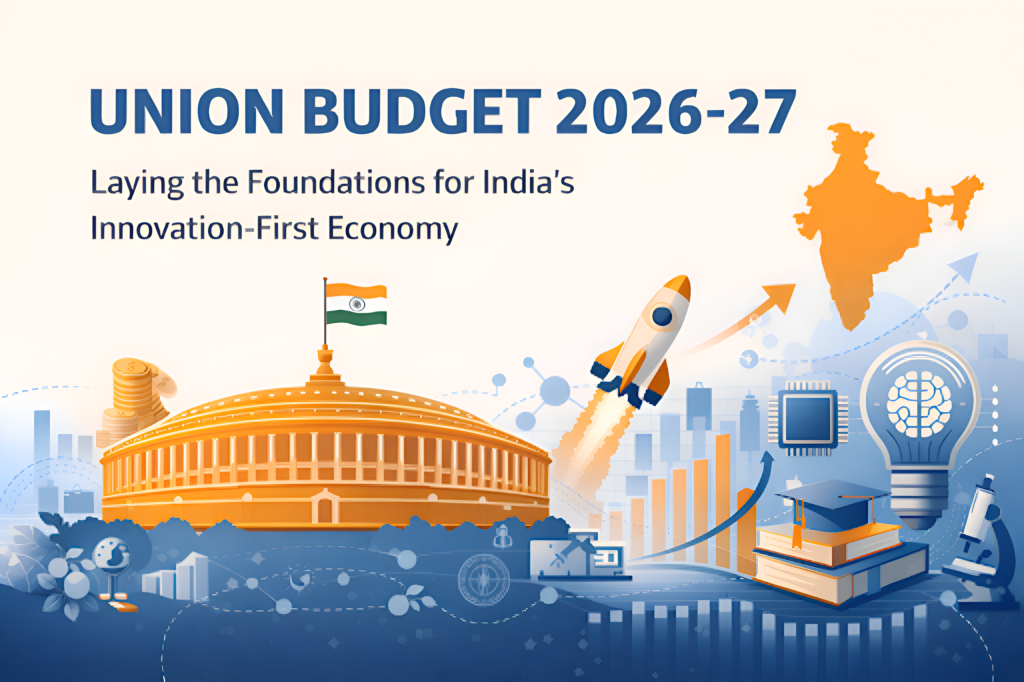
India’s Union Budget 2026–27 signals a decisive shift towards building a technology-driven, innovation-led, and entrepreneur-friendly economy. Presented at a time when India is positioning itself as a global hub for startups, advanced manufacturing, and digital services, the Budget places strategic emphasis on funding access, deep tech, education–employment alignment, and capacity building – critical pillars of the Viksit Bharat vision.
Strengthening the Startup and Funding Ecosystem
A major highlight of the Budget is the renewed commitment to startup financing. The government has announced three separate outlays of ₹10,000 crore each, including a fresh infusion into the Fund of Funds for Startups (FFS). This capital, to be deployed through SEBI-registered venture capital and alternative investment funds, is expected to catalyse early- and growth-stage startups across sectors.
In addition, a ₹2,000 crore top-up to the Self-Reliant India Fund ensures continued support for scaling enterprises, particularly those emerging from non-metro regions. Together, these measures deepen India’s risk capital ecosystem and address one of the most persistent challenges faced by startups – patient, growth-oriented funding.
Technology, AI, and Semiconductor Push
The Budget also sharpens India’s focus on strategic technologies. The expansion of the India Semiconductor Mission, with enhanced allocations and a stronger emphasis on hardware manufacturing, marks India’s transition to the next phase of its electronics and chip-making ambition.
On the digital front, the government has taken a significant step towards AI governance and clarity for IT services by raising the safe harbour threshold from ₹300 crore to ₹2,000 crore, providing much-needed certainty to India’s IT and technology services sector.
The launch of “Bharat-VISTAAR,” a multilingual AI-powered platform for farmers, underscores the government’s intent to deploy artificial intelligence for inclusive growth, improving productivity, market access, and decision-making in agriculture.
Education, Skills, and Creative Economy
Education and skilling emerge as central enablers of India’s innovation economy. Finance Minister Nirmala Sitharaman announced initiatives spanning STEM education, healthcare skills, creative industries, and professional training.
Key announcements include:
● Establishment of three new NIPERs, upgrading seven existing institutes, and creating a network of 1,000 accredited clinical trial centres
● Training one lakh allied health professionals through select higher education institutions
● Expansion of AVGC and content creator labs across 15,000 schools and 500 colleges, strengthening India’s animation, gaming, and digital content ecosystem
● New design and Ayurveda institutes, alongside modern short-term courses by ICAI and ICSI, with a focus on Tier-2 and Tier-3 cities
The proposed AI Mission, National Research Fund, Innovation Fund, and the Education-to-Employment and Entrepreneurship Committee further reinforce the Budget’s intent to tightly integrate education with industry and jobs.
ICTRD and the Viksit Bharat Mission
The International Centre for Technical Research and Development (ICTRD) welcomes the Union Budget 2026–27 as a forward-looking blueprint for India’s innovation economy. ICTRD is already working on similar lines, building the foundations of Viksit Bharat through courses, training programs, incubation support, policy dialogue, and industry–academia collaboration.
By convening educators, entrepreneurs, policymakers, and technology leaders, ICTRD contributes to shaping future-ready skills, innovation ecosystems, and entrepreneurship pathways that translate policy intent into on-ground impact.
The Union Budget 2026–27 makes it clear that India’s next phase of growth will be driven not just by scale, but by ideas, institutions, and innovation. As startups gain access to capital, technologies mature, and education systems evolve, ecosystem enablers like ICTRD will play a critical role in ensuring that India’s demographic and digital advantages convert into sustainable global leadership.