
The Virtual Round Table organized by the Indian Council for Technical Research and Development (ICTRD) on April 10, 2026, brought together a diverse group of experts, academicians, and industry professionals to deliberate on one of the most pressing questions of our time: how India will respond to a rapidly transforming global landscape.
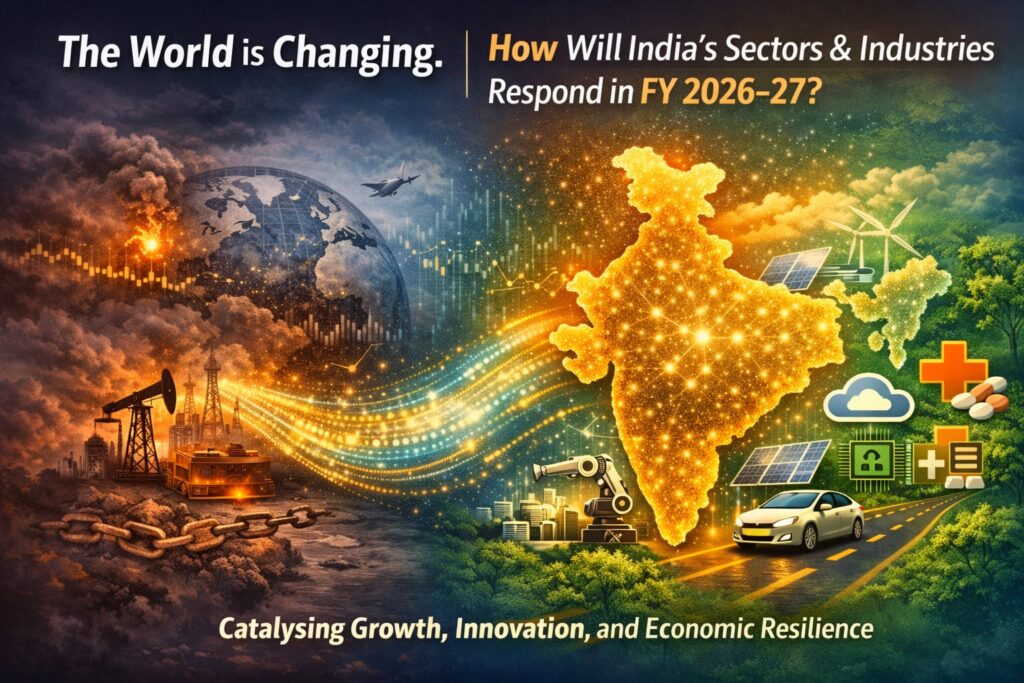
At a time when the world is witnessing structural shifts driven by geopolitical realignments, technological disruptions, climate pressures, and evolving economic dynamics, the discussion highlighted that Financial Year 2026–27 will be a defining period for India’s growth journey.
A Changing Global Landscape and India’s Position
Opening the session, Siddharth Roy, Director of Communication, set the tone by emphasizing that global changes today are not isolated events but interconnected transformations impacting industries, supply chains, and economies worldwide.
He highlighted that India, while emerging as a strong global economic player, must navigate these changes with agility and preparedness. From MSMEs to large enterprises and from startups to the education sector, every segment will need to adapt to new realities shaped by uncertainty, innovation, and competition.
Building on this, Dr. Ketan Mohitkar, Member Secretary of ICTRD, underscored that the world is not merely evolving but undergoing a fundamental transformation. He noted that India stands at a critical juncture supported by strong domestic growth yet deeply linked to global systems.
He emphasized that FY 2026–27 will test India’s ability not just to respond to change, but to lead with resilience, innovation, and strategic clarity.
From Growth to Global Leadership: A Structural Shift
A key theme that emerged across discussions was the transition from traditional growth models to a more resilient and innovation-led framework.
Experts highlighted that nations are no longer competing solely on cost efficiency, but on their ability to innovate, sustain, and respond to disruptions. India’s demographic strength, digital infrastructure, and policy initiatives such as Make in India and Digital India position it uniquely in this transformation.
However, the focus is gradually shifting from vision to execution where speed, precision, and collaboration will determine long-term success.
Technology as the Core Driver of Transformation.
Across sectors, technology emerged as the most significant force shaping the future.
Artificial Intelligence, data analytics, cloud computing, and emerging technologies like quantum computing are redefining industries from IT and manufacturing to agriculture and healthcare. The shift from traditional systems to AI-driven, platform-based ecosystems is not only improving efficiency but also changing how businesses operate and deliver value.
The discussion also highlighted a transition from labor-driven models to intelligence-driven systems, where innovation, automation, and digital capabilities are becoming central to growth.
Sectoral Transformation: A Multi-Dimensional Shift
The round table provided a comprehensive view of how different sectors are evolving:
● Manufacturing is moving towards high-value, technology-driven production, supported by initiatives like PLI and Industry 4.0
● IT and Digital Economy are shifting towards AI-powered solutions, cybersecurity, and platform-based growth
● Agriculture is transforming through precision farming, climate resilience, and digital integration
● Startups are focusing on sustainable value creation, deep tech, and climate innovation
● Infrastructure is emerging as a backbone of growth, driven by smart technologies and
improved execution models.
This transformation reflects a broader shift from cost minimization to resilience maximization, where long-term sustainability is becoming a priority.
Perspectives from Participating Experts
The discussion was further enriched by insights from a diverse group of speakers across sectors.
● Mr. Mahesh Prasad Mishra highlighted the importance of execution, innovation, and sustainability in shaping India’s growth.
● Dr. Amol Bhagwat Kasture emphasized adaptability in the face of rapid technological and global shifts.
● Dr. Nunna Venkata Ramana underlined the need for balanced sectoral growth and stronger focus on education and research.
● Mr. Akhil Garg spoke about continuous learning and adapting to AI-driven transformation.
● Mr. Sumit Kumar Ghosh reflected on the growing impact of emerging technologies and renewable energy.
● Dr. Anshuman Sharma highlighted the evolution of India’s service sector and the importance of skills and digital infrastructure.
Workforce, Skills, and Adaptability
Another central theme was the evolving nature of work.
As industries adopt advanced technologies, the demand for new-age skills is rising rapidly. Technical expertise in AI, data science, and digital systems is becoming essential, but equally important are soft skills such as adaptability, creativity, and continuous learning.
Experts emphasized that organizations must invest in upskilling and reskilling their existing workforce, ensuring that growth is inclusive and sustainable. The future workforce will not just be defined by knowledge, but by its ability to adapt to constant change.
Sustainability and Responsible Growth
Sustainability emerged as a key pillar across discussions.
From renewable energy adoption and electric mobility to ESG-driven business models, there is a clear shift towards environmentally responsible growth. Experts noted that sustainability is no longer just a compliance requirement,but a competitive advantage in the global economy.
The transition towards renewable energy systems and efficient resource utilization reflects a broader commitment to long-term resilience and environmental balance.
Challenges on the Path Ahead
While the opportunities are significant, the discussion also highlighted critical challenges:
● Skill gaps and workforce readiness
● Execution delays and infrastructure inefficiencies
● Regulatory complexities
● Supply chain vulnerabilities
● Climate risks and resource constraints
A recurring insight was that India’s challenge is not a lack of vision, but the need for faster and more effective execution.
ICTRD and the Role of Collaborative Platforms
The Indian Council for Technical Research and Development (ICTRD) continues to play a vita role in enabling such meaningful dialogues.
By bringing together stakeholders from academia, industry, policy, and innovation ecosystems, ICTRD fosters knowledge exchange, collaboration, and actionable insights. These platforms help translate ideas into strategies and contribute to building a future-ready India.