
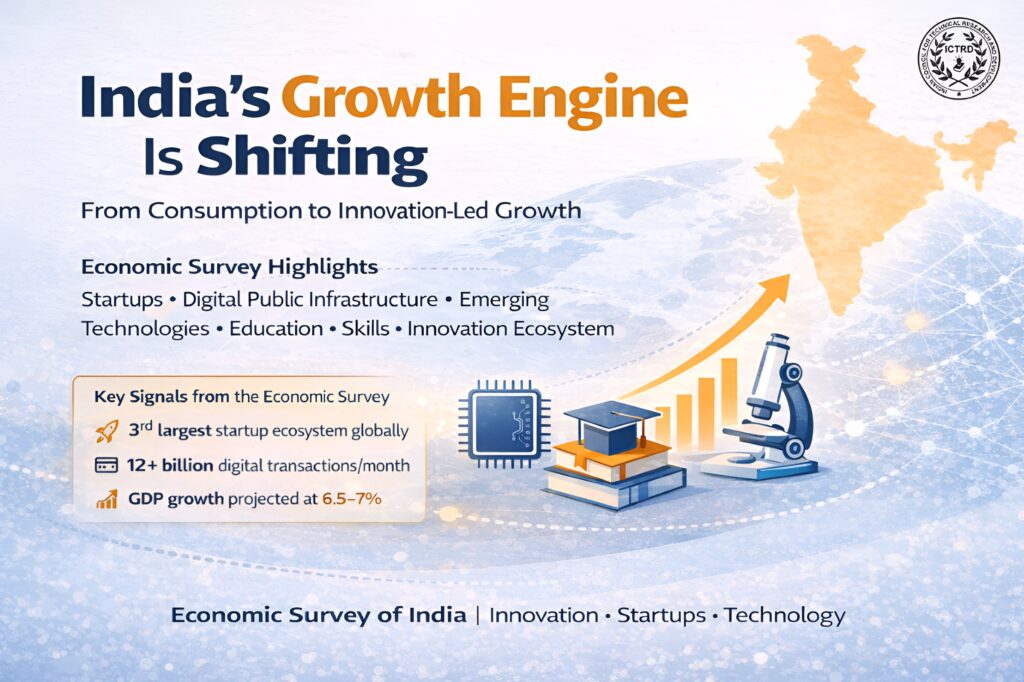
India’s latest Economic Survey of India presents a confident and forward-looking assessment of the
country’s economic trajectory, underscoring innovation, technology, and entrepreneurship as central
pillars of India’s long-term growth. At a time of global uncertainty, the Survey positions India as a resilient,
reform-driven economy steadily transitioning from consumption-led growth to an innovation- and
productivity-led model.
According to the Survey, India remains one of the fastest-growing major economies, with real GDP
growth projected in the range of 6.5–7%, driven by strong domestic demand, public capital expenditure,
and expanding digital infrastructure. Crucially, the Survey highlights that future growth will increasingly
depend on technological adoption, startup dynamism, and human capital development.
Innovation and the Startup Economy
India’s innovation ecosystem has matured significantly over the past decade. The Economic Survey notes
that India is now the third-largest startup ecosystem globally, with over 1 lakh DPIIT-recognised
startups, creating millions of direct and indirect jobs. Sectors such as fintech, health tech, climate tech,
deep tech, and AI are witnessing rapid scale-up, supported by improved access to capital and policy
stability.
The Survey also emphasises that innovation is no longer confined to metros. Tier-2 and Tier-3 cities now
account for a growing share of new startups, reinforcing the idea that inclusive innovation is becoming a
national phenomenon. This decentralisation of entrepreneurship aligns with India’s broader goal of
balanced regional development.
Technology as a Growth Multiplier
A defining theme of the Survey is the role of Digital Public Infrastructure (DPI), including Aadhaar, UPI,
and ONDC—in lowering transaction costs, improving productivity, and enabling new business models.
India’s digital payments ecosystem alone now processes over 12 billion transactions per month,
making it one of the largest in the world.
The Survey highlights that digitalisation has improved formalisation across sectors, enhanced tax
compliance, and created fertile ground for technology-led enterprises. Emerging technologies such as
artificial intelligence, semiconductors, advanced manufacturing, and green technologies are identified as
critical to India’s next phase of growth.
Education, Skills, and Future Readiness
The Economic Survey clearly links India’s economic aspirations with education and skilling reform.
With over 65% of India’s population below the age of 35, the Survey stresses the urgency of aligning
education with industry needs, fostering research-led institutions, and promoting lifelong learning.
Global evidence cited in the Survey suggests that countries investing in applied research, technical
education, and industry-academia collaboration achieve higher productivity growth and innovation
outcomes, areas where India is actively strengthening its ecosystem.
ICTRD and the Viksit Bharat Vision
The Survey’s emphasis closely mirrors the Viksit Bharat 2047 vision, an India that is innovative,
self-reliant, inclusive, and globally competitive. The Indian Council for Technical Research and
Development (ICTRD) works on similar lines by enabling structured dialogue between policymakers,
educators, industry leaders, and innovators.
Through research-driven round tables, knowledge exchanges, and global collaborations, ICTRD
contributes to strengthening innovation ecosystems, future skills discourse, and technology-led
education frameworks, ensuring that economic growth is sustainable, inclusive, and rooted in capability
building.
India’s Economic Survey makes it clear that the country’s next leap will not be driven by scale alone, but
by ideas, innovation, and institutions. As startups scale, technologies evolve, and education systems
transform, platforms like ICTRD will play a critical role in translating policy intent into measurable
impact—helping shape an India that is not just growing, but leading.